LLC vs. S-Corp vs. C-Corp: Choosing the Best Business Structure for Startup Funding in 2025
Unlock your startup’s full potential for funding success. This guide compares the LLC, S-Corp, and C-Corp to help you select the optimal business structure for startup funding in 2025, considering investor appeal, tax implications, and growth.
Why Your Business Structure is Critical for Startup Funding in 2025
Choosing the right legal structure is one of the most pivotal decisions any founder can make – especially when your sights are set on raising capital. Your business entity type isn’t just about paperwork; it profoundly impacts how you’re taxed, your personal liability, and, most importantly, how attractive your company looks to potential lenders and startup investors.
In 2025, understanding the nuances between an LLC, S-Corp, and C-Corp is crucial. A well-chosen business structure can streamline your path to securing investment, while a mismatched one can create unnecessary hurdles. Let’s break down the key differences and show you how to structure smartly for startup funding success and sustainable growth.
LLC: The Flexible & Simple Choice for Early-Stage Startups & Debt Funding
Limited Liability Companies (LLCs) remain a top choice for small businesses and many bootstrapped startups due to their inherent simplicity and flexibility. They offer robust personal liability protection, shielding your personal assets from business debts and lawsuits. Additionally, LLCs typically benefit from pass-through taxation, meaning profits are taxed only once at the personal level, effectively avoiding the “double taxation” problem inherent in standard corporations.
- Ease of Formation and Management: LLCs demand less ongoing paperwork and fewer stringent corporate formalities compared to corporations, making them highly appealing for new founders focusing on rapid iteration.
- No Double Taxation (Default): By default, profits and losses “pass through” directly to the owners’ personal income, avoiding the corporate tax layer.
- Flexible Profit Distribution: Owners can distribute profits as they see fit, regardless of their exact ownership percentage, offering great operational flexibility.
- Ideal for: Service businesses, consultants, solo founders, and startups primarily seeking debt financing or not immediately targeting institutional venture capital.
Funding Tip for LLCs: While many traditional equity investors, particularly VCs, often prefer C-Corporations, LLCs absolutely can raise capital. They are particularly well-suited for debt financing, such as unsecured lines of credit from partners like Fundwise Capital, or revenue-based financing models. For a deeper dive into credit building strategies, read our guide on Fund and Grow Business Credit. For angel investors or friends & family rounds, an LLC can sometimes work if structured carefully, but founders should be aware that a future conversion to a C-Corp might be necessary for larger, institutional equity rounds.
Form your LLC easily: To ensure your business starts on the right legal footing, use Northwest Registered Agent. They provide fast, affordable LLC formation in any U.S. state, including essential registered agent service.
S-Corp Tax Election: Optimize Profit & Credibility for Growing Businesses
It’s crucial to understand that an S-Corporation is not a legal entity type in itself, but rather a tax election made with the IRS. This election can be applied to either an LLC (making it an “LLC taxed as an S-Corp”) or a C-Corporation. Once your business becomes profitable, electing S-Corp status can unlock significant tax savings, primarily by reducing self-employment taxes for active owners.
With an S-Corp election, you, as an owner, can split your income into two parts: a “reasonable salary” (subject to payroll taxes) and “distributions” (which are not subject to self-employment taxes). This strategy can lead to substantial tax savings as your profits grow, particularly for service-based businesses with lower overheads.
- Significant Self-Employment Tax Savings: The primary financial benefit for profitable businesses and owner-operators.
- Pass-Through Taxation: Similar to an LLC, profits are taxed only once at the shareholder level, avoiding the corporate tax layer.
- Increased Credibility: Electing S-Corp status can sometimes lend more credibility to your business with certain lenders and partners, signaling a more formal and tax-optimized structure.
- Great for: Service-based businesses with consistent profits, such as digital agencies, consulting firms, or professional practices, looking to reduce their personal tax burden.
Accounting Tip for S-Corps: Correctly managing payroll for your “reasonable salary” and tracking distributions is absolutely crucial for S-Corp compliance with the IRS. Professional accounting tools like Xero (for robust accounting software) or Bench (for done-for-you bookkeeping services) are highly recommended to ensure you stay compliant and effectively optimize your tax situation.
C-Corp: The Investor-Ready Structure for Venture Capital & High-Growth Startups
If your startup is engineered for rapid, scalable growth and is actively seeking significant external investment – particularly from venture capital (VC) funds or plans for a public offering – the C-Corporation is almost universally the required and preferred legal structure. It offers distinct advantages for large-scale investment and complex equity arrangements, though it does come with specific tax implications.
- Preferred by Institutional Investors and VCs: C-Corps allow for unlimited shareholders, the issuance of different classes of stock (e.g., common vs. preferred shares, which VCs demand), and standard governance models that institutional investors are familiar with and require. This simplifies complex equity investments and future funding rounds.
- Essential for Equity Raises: The standard for businesses aiming for rapid, scalable growth through external equity investment, especially from venture capitalists, angel networks, and large institutional funds.
- Required for Most Equity Crowdfunding Platforms: Platforms like Wefunder or StartEngine typically mandate a C-Corp structure for companies seeking to raise capital from a large number of small investors (equity crowdfunding).
- Double Taxation (Important Consideration): Corporate profits are taxed at the corporate level, and then again when distributed to shareholders as dividends. However, many high-growth startups reinvest profits back into the company to fuel expansion, mitigating this “double taxation” until a major exit event (like an acquisition or IPO).
- Unlimited Growth Potential: No restrictions on the number of shareholders, making it the ideal structure for massive scale and eventual public offerings.
Funding-Ready Tip: If you’re planning to raise from institutional investors, structuring as a Delaware C-Corp is often considered the industry standard due to Delaware’s favorable corporate laws and established legal precedents.
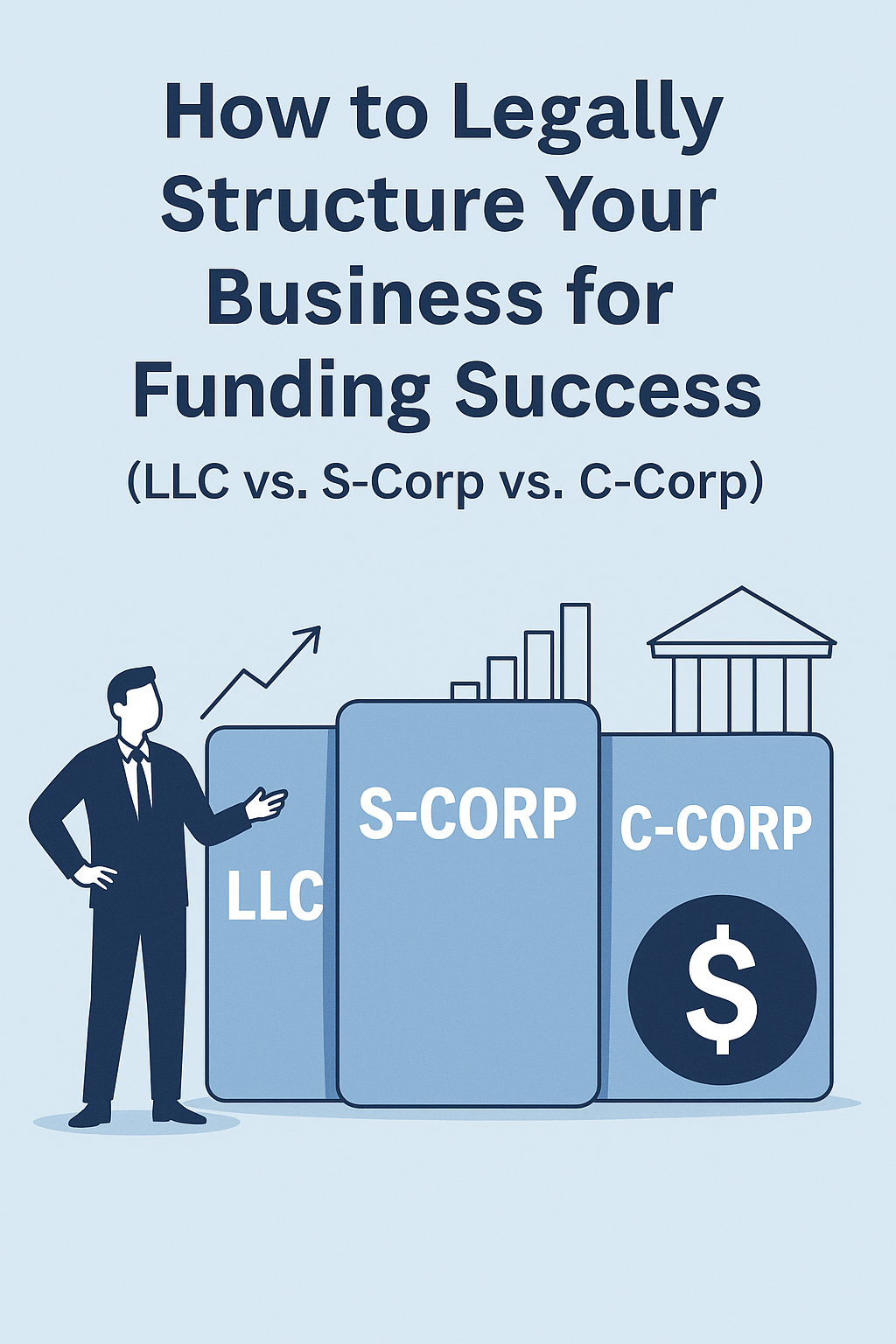
Side-by-Side Comparison: LLC vs. S-Corp vs. C-Corp for Funding
Here’s a quick reference table to help you compare the key aspects of these business structures and their implications for funding:
| Criteria | LLC | S-Corp (Tax Election) | C-Corp |
|---|---|---|---|
| Best For | Simplified businesses, solo founders, low-risk ventures, debt financing | Profitable service businesses, tax savings for owners | Startups raising equity capital, aiming for high growth/exit (VC) |
| Taxation | Pass-through (single taxation) | Pass-through with self-employment tax savings on distributions | Double taxation (corporate profit + shareholder dividends) |
| Investor Appeal (Equity) | Low (often requires C-Corp conversion for VCs) | Moderate (some angels, but VCs almost always require C-Corp) | High (standard for VCs, institutional investors) |
| Ongoing Compliance | Simple (minimal meetings, paperwork) | Moderate (requires payroll, reasonable salary rules) | High (board meetings, extensive record-keeping, strict formalities) |
| Scalability (Shareholders) | Limited (can be complex with many owners) | Limited (max 100 shareholders, only U.S. citizens/residents) | Unlimited shareholders, flexible equity classes (preferred, common) |
| Personal Liability | Strong protection for owners | Strong protection for owners (as underlying entity) | Strong protection for owners |
Choosing the Best Business Entity for Your Startup’s Funding Goals
The best business structure for funding largely depends on your long-term vision and specific funding strategy:
- For Simplicity & Debt Funding: If you’re just starting out, want solid personal liability protection, and plan to self-fund or seek debt financing (like lines of credit or traditional loans), an LLC is a smart, flexible move. Remember to check out our SBA Loan Checklist 2025 if government-backed loans are part of your plan. You can always convert to a C-Corp later if venture capital becomes a goal.
- For Tax Efficiency (Once Profitable): As your LLC or C-Corp becomes profitable, electing S-Corp status can bring significant tax savings by reducing self-employment taxes. This is a common and excellent choice for growing service businesses with consistent profits.
- For Venture Capital & High Growth: If you’re building a scalable startup with the intent to raise significant equity capital from venture capitalists or angel investors, a C-Corp (often a Delaware C-Corp) is almost always the required and preferred structure. This choice immediately signals your intent for rapid growth and an eventual exit.
Each path has its unique trade-offs in terms of taxes, ongoing compliance, and investor appeal. The most important thing is to build your legal foundation to strategically support the kind of growth and funding you want. A well-chosen business structure can significantly smooth your path to securing investment, while a mismatched one can create unnecessary administrative and legal hurdles.
For more detailed insights on what lenders specifically look for, refer to our Ultimate Business Loan Approval Checklist.
Consider consulting with a legal or tax professional to ensure your choice aligns perfectly with your specific business model and funding strategy for 2025 and beyond.
Essential Tools for Business Formation & Funding Success
Getting your legal entity established and your financials in impeccable order is paramount for funding success. These trusted partners can help you navigate the complexities:
- Northwest Registered Agent: For fast, affordable, and reliable entity formation (LLC, C-Corp, S-Corp election assistance) and crucial registered agent service. Essential for legally establishing your business structure and maintaining compliance.
- Fundwise Capital: Pre-revenue or early-stage? Explore options for unsecured lines of credit (up to $150K) to get you started, often with no upfront fees. This is highly relevant for LLCs and early-stage businesses seeking non-dilutive capital, and you can learn more about building credit through them in our dedicated guide.
- Xero: Simple, scalable accounting software that grows with your business. Crucial for maintaining accurate, investor-ready financial records, which is vital for both tax compliance (especially for S-Corps and C-Corps) and attracting investors.
- Bench: Hands-off bookkeeping services from a team of professional bookkeepers. Ideal if you prefer to outsource your financial record-keeping, ensuring clean and organized books for any funding application or due diligence.
- For Equity Crowdfunding: If you opt for a C-Corp and plan to raise via crowdfunding, platforms like Wefunder or StartEngine can be powerful tools to access a broad investor base (consider adding specific affiliate links here if applicable, or links to content about these platforms).
Conclusion: Structure Your Business Smartly for Funding Success in 2025
Your chosen legal structure is the fundamental cornerstone for your startup’s funding, tax obligations, and long-term growth trajectory. Don’t pick blindly—choose with clear purpose, carefully aligning your entity with your ultimate funding goals and business aspirations. With the right business structure in place from day one, you’ll be strategically positioned to raise capital more efficiently, stay compliant, and scale your business faster in 2025 and beyond.
Need personalized guidance for your startup’s legal structure? Utilize our recommended partners to ensure you start strong and structure smart. Reach out if you’d like further personalized recommendations for your unique startup funding journey.