Business Line of Credit vs Term Loan: Which Gives Your Startup More Flexibility in 2025?
Every startup founder knows that cash flow is the lifeblood of a growing business. Whether you are managing daily operations, seizing new opportunities, or navigating unexpected challenges, access to capital is crucial. But when it comes to business financing, the options can feel overwhelming. Two of the most common and powerful tools in a startup’s arsenal are a business line of credit and a term loan. Choosing the right one can significantly impact your financial agility and growth trajectory in 2025.
So, which funding type offers your startup more flexibility: a business line of credit or a term loan? Let’s dive into the core differences, explore their ideal use cases, and help you determine the best path forward for your business.
—
Understanding Business Lines of Credit
Think of a business line of credit like a credit card for your business, but often with better terms and higher limits. It’s a revolving credit facility, meaning you get access to a set amount of funds that you can draw from as needed, repay, and then draw from again. You only pay interest on the amount you actually use, not on the entire approved limit.
Key Characteristics of a Business Line of Credit:
- Revolving access to funds up to an approved limit.
- Interest is charged only on the drawn amount.
- Flexible repayment, often minimum monthly payments on the drawn balance.
- Ideal for managing short-term cash flow gaps, unexpected expenses, or seizing immediate opportunities.
- Can be secured (by collateral) or unsecured.
For startups, a line of credit offers unparalleled flexibility. It acts as a financial safety net, ready to deploy when inventory needs replenishing, a marketing campaign demands quick funding, or an unforeseen repair crops up. It’s particularly useful for businesses with fluctuating revenues or seasonal cycles. For more details on this, Investopedia provides a comprehensive guide on what a line of credit is.
—
Understanding Term Loans
A term loan is a lump sum of money that a business borrows and repays over a fixed period (the “term”) with regularly scheduled payments, including both principal and interest. Once you repay a portion of the loan, those funds are not typically available to re-borrow.
Key Characteristics of a Term Loan:
- Lump sum of capital disbursed upfront.
- Fixed repayment schedule (e.g., monthly) over a set period.
- Interest is charged on the entire principal amount.
- Best for specific, larger investments like equipment purchases, facility expansion, or major inventory buys.
- Can be short-term (under a year) or long-term (several years).
Term loans provide predictability. You know exactly what you owe and when, making budgeting straightforward. They are excellent for funding specific growth initiatives that require a substantial, one-time injection of capital. The U.S. Small Business Administration (SBA.gov) offers various term loan programs specifically designed for small businesses.
—
Business Line of Credit vs Term Loan: A Side-by-Side Comparison
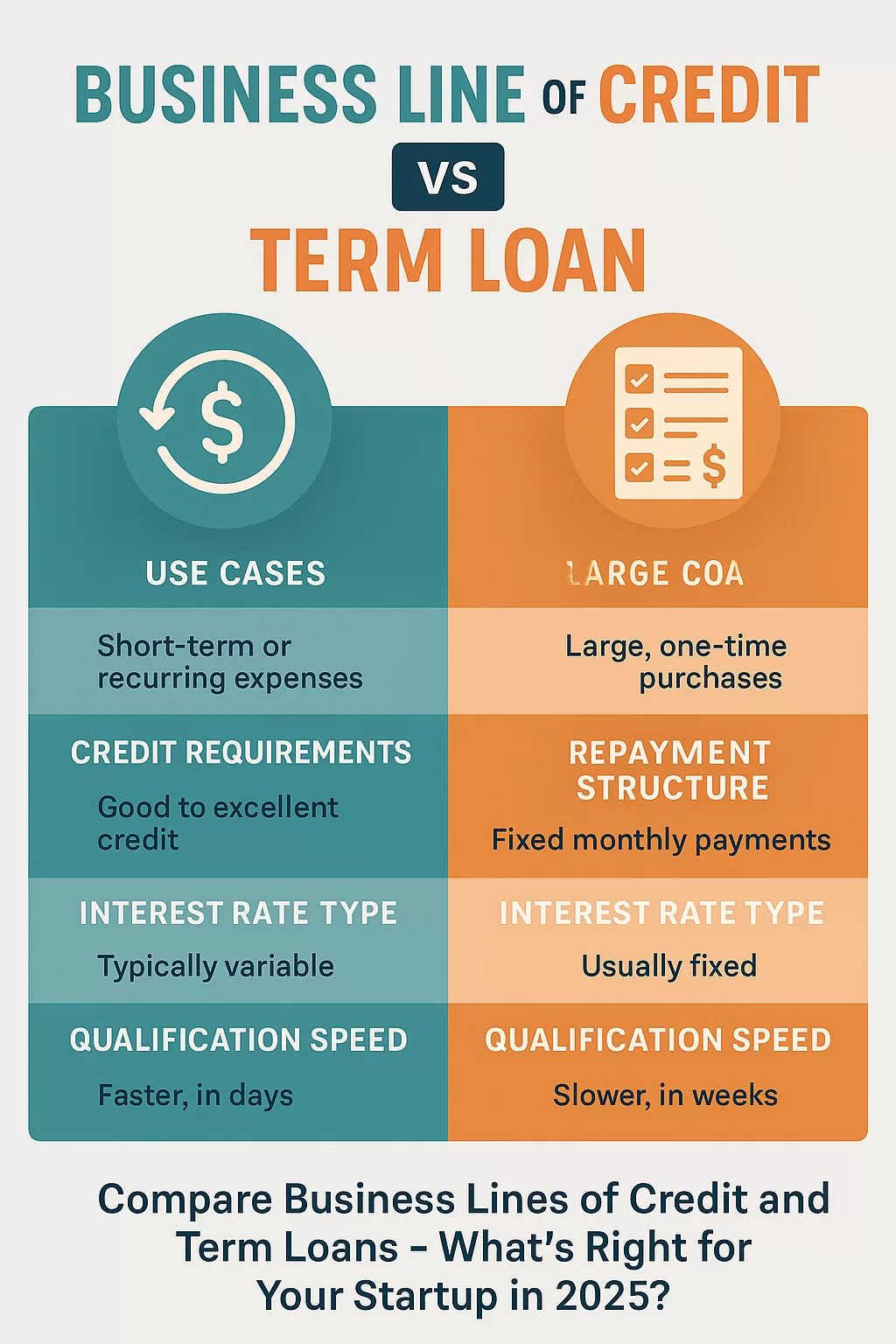
To help you see the differences at a glance, here’s a comparison table:
| Feature | Business Line of Credit | Term Loan |
|---|---|---|
| Typical Use Cases | Working capital, payroll, inventory, short-term gaps, emergencies, seasonal needs | Equipment purchase, facility expansion, large-scale projects, debt refinancing, significant growth initiatives |
| Qualification Criteria | Credit score (personal & business), time in business, revenue, cash flow | Stronger credit score, longer time in business, consistent revenue, detailed business plan, collateral often required |
| Interest Types | Variable (most common), charged only on drawn amount | Fixed (most common), charged on entire principal |
| Repayment Structure | Flexible; pay only on what you use; revolving access | Fixed monthly payments over a set term; no re-borrowing |
| Speed of Funding | Often faster once approved; readily available as needed | Can take longer for approval and disbursement of lump sum |
| Flexibility | High; use and repay as needed, funds replenish | Lower; one-time lump sum, fixed repayment schedule |
| Best For | Ongoing operational needs, managing fluctuations, emergency fund | Large, specific capital expenditures, predictable long-term investments |
—
When to Use Each Funding Option
Choosing between a line of credit and a term loan boils down to your specific business needs and how you plan to use the funds.
Use a Business Line of Credit When:
- You need an emergency fund or a financial buffer for unexpected expenses.
- Your business has seasonal fluctuations in cash flow (e.g., retail, agriculture).
- You need to bridge short-term gaps in receivables or pay for immediate inventory.
- You want flexibility to draw and repay funds repeatedly without reapplying.
- You are managing payroll and operational expenses on an ongoing basis.
Use a Term Loan When:
- You have a specific, large-scale project or purchase in mind (e.g., new machinery, office expansion).
- You want predictable monthly payments and a clear repayment timeline.
- You need a significant lump sum upfront to fund a major growth initiative.
- You are looking to refinance existing high-interest debt into a more manageable structure.
- Your business has a stable revenue stream that can support consistent repayments.
—
How to Apply and Get Funded in 2025
No matter which option you choose, working with trusted financial partners is key to a smooth application process. Here’s how you can take the next step:
✅ Apply for a Line of Credit with Fundwise Capital
Fundwise Capital specializes in helping startups and small businesses secure lines of credit. Their streamlined process can help you get access to the flexible capital you need quickly. Check your eligibility today to see what options are available for your business.
✅ Get a Term Loan Quote with National Funding
National Funding is a leading provider of small business loans, offering various term loan options tailored to your business’s growth plans. They understand the unique needs of startups and can help you secure the lump sum financing required for your next big investment.
For more insights on securing business funding, check out these related posts from our blog:
- Fast Business Loans with Minimal Paperwork
- Building Business Credit for Startups Guide
- SBA Loan Checklist 2025
- Business Loan vs. Business Credit Card
- Business Credit vs. Business Loans
You can also explore other funding avenues discussed on reputable sites like NerdWallet’s guide to business loans to further understand your options.
—
Frequently Asked Questions (FAQ)
What is the main difference in flexibility?
A business line of credit offers significantly more flexibility as it’s a revolving credit facility. You can borrow, repay, and re-borrow funds up to your limit, paying interest only on the amount you’ve used. A term loan provides a lump sum once, and once repaid, those funds are no longer available unless you apply for a new loan.
Which is better for a brand-new startup?
For brand-new startups, securing either can be challenging without established revenue or credit history. However, some lenders offer lines of credit specifically designed for newer businesses. Term loans often require a more robust track record. It depends on your specific needs: a line of credit for operational flexibility, or a term loan for a specific, larger initial investment.
Do I need collateral for these loans?
It depends on the lender and the specific loan product. Many business lines of credit are unsecured, especially for businesses with good credit and cash flow. Term loans, particularly larger ones, are often secured by collateral such as real estate, equipment, or accounts receivable.
Can I have both a line of credit and a term loan?
Yes, many businesses utilize both a line of credit and a term loan. They serve different purposes: the line of credit for day-to-day operational liquidity and the term loan for long-term strategic investments. This combination can provide comprehensive financial support.
How do interest rates compare?
Interest rates vary widely based on the lender, your business’s creditworthiness, and market conditions. Generally, interest rates on lines of credit can be variable, while term loans often have fixed rates. The overall cost will depend on how much you draw on a line of credit versus the full principal of a term loan.
This post may contain affiliate links. We may earn a commission when you click one of these links and make a purchase.